THE CODE OUTPUT EXPERIENCE

Write code. See the output.
Understand what you build.

Code output is one of the most important parts of programming because it lets you see what your code actually does. JS CODE OUTPUT brings that idea into a clear browser-based experience where you can write code, run it, inspect the result and understand the connection between your code and the output it creates.

CODE → OUTPUTWrite code and immediately check the result
LIVE OUTPUTSee what your JavaScript produces
FAST FEEDBACKRun, check, change and test again
WHY CODE OUTPUT MATTERS

Code output is where your code becomes understandable.

The platform brings the important parts of web development closer together, so you can focus on the thing that matters most — building. The live workspace, project structure, coding tools, preview and publishing flow are designed to make the journey from idea to finished website easier to understand and faster to repeat.

Why seeing code output is so important

A great code editor is not only about typing code. It is about reducing the distance between an idea, the code that creates it and the result that people actually see. JS CODE OUTPUT is designed around that relationship. You can work with HTML for structure, CSS for appearance and JavaScript for interaction in the same browser-based environment, while the live output gives you a direct visual connection to what you are creating. That makes the workflow useful for beginners learning by experimentation, creators building visual ideas and developers who want a focused place to test frontend concepts quickly.

The experience is also designed to grow with a project rather than treating every experiment as a disposable snippet. Projects can keep their own files organized, the editor can work with multiple project files, and the wider platform includes features such as libraries, saving, publishing and export. In other words, JS CODE OUTPUT is positioned not simply as a place to type HTML, but as a practical path from writing the first line of code to testing and sharing a real browser-based project.

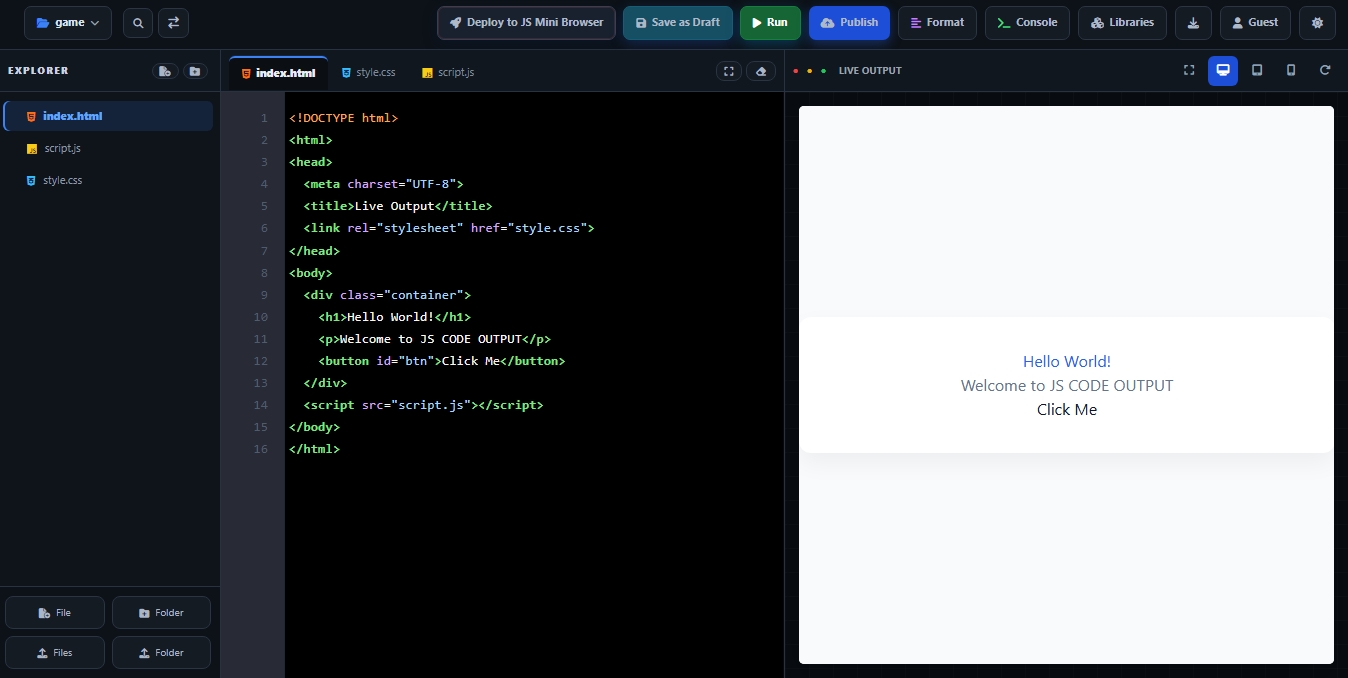
JS CODE OUTPUT workspace and live preview
CODE OUTPUT IN PRACTICE

A clear place to write, run and understand your code.

Instead of writing code in one application and repeatedly opening another application to inspect the result, the workspace keeps the source and output together. This makes small experiments easier, debugging more visual and the build-test-change cycle much more natural.

01 / WRITE

Write your code

Start by writing JavaScript directly in the editor. The focused input area keeps your code easy to read and gives you a simple place to experiment with statements, variables, functions, calculations and logic before checking the result.

02 / RUN

Run the code

Running the code turns your written JavaScript into an actual result. Instead of wondering whether the program will behave correctly, you can execute it and immediately move to the output stage.

03 / OUTPUT

See your output

The Code Output panel gives you a direct place to see the result produced by your JavaScript. Console messages and calculated values become visible, making it easier to understand exactly what your code is doing.

04 / ERRORS

Catch mistakes

When JavaScript encounters a runtime problem, seeing the error as part of the output experience helps you identify that something needs attention. You can fix the code and run it again to confirm the change.

05 / ITERATE

Improve with feedback

Output makes the improvement cycle simple: change the code, run it again, compare the result and keep refining. This repeated feedback is one of the most useful habits a programmer can develop.

06 / BUILD

Turn output into projects

Code output is the foundation for larger work. Once you understand what your JavaScript produces, the same ideas can be combined with HTML and CSS to create interactive webpages, components, tools, experiments and complete web projects.

CODE OUTPUT

Why seeing your output makes coding dramatically easier.

Instant visual feedback

When HTML, CSS and JavaScript work together, the live preview shows the resulting webpage beside the code. You can change a heading, button, spacing, color, layout or interaction, run the project and immediately compare the change with the result.

Better for responsive design

Live output is especially useful when a design needs to work across different screen sizes. Instead of guessing whether a layout will behave correctly, you can test the actual rendered interface and refine the structure and styling as you build.

Learn by seeing

For a learner, the connection between a line of code and a visible result is incredibly valuable. You write something, see what it changes, discover what went wrong and adjust it. That repeated cycle turns abstract syntax into something visual and understandable.

Write once. Watch it become a website. The closer your code and output are, the easier it becomes to experiment, understand, test and improve.
code-output.js
LIVE OUTPUT > Hello, World! ✓ rendered successfully
CODE OUTPUT FOR CREATIVE WORK

See the result of your code while you create.

JS CODE OUTPUT is particularly useful for animation experiments because the technologies that create modern browser motion are already at the center of the workflow. CSS can handle transitions, transforms, keyframes, hover effects, loaders, reveals, moving backgrounds and many other visual effects, while JavaScript can control timing, user interaction, state and more advanced behavior. Because the live result sits directly beside the code, you do not have to imagine what a timing value or transform will look like — you can change it, run it and see the motion immediately.

That makes animation development much more approachable. You can start with a simple fade or movement, then gradually combine transforms, easing, delays, keyframes and JavaScript-driven interactions into richer experiences. For creators who enjoy making interfaces feel alive, this tight code-to-preview loop is one of the strongest reasons to use a browser-first editor: the creative experiment and the finished visual are always close together.

CODE → OUTPUT → IMPROVEMENT

A simple workflow for understanding your code.

01 / HTML

Structure

HTML defines what exists on the page — headings, paragraphs, images, links, buttons, forms, sections and the rest of your content.

02 / CSS

Design

CSS controls how that structure looks and behaves visually through typography, spacing, colors, layouts, responsive rules, transitions and animations.

03 / JAVASCRIPT

Interaction

JavaScript adds logic and dynamic behavior, from button interactions and menus to DOM updates, form validation, data handling and more advanced browser experiences.

04 / OUTPUT

See it live

Run the project and inspect the rendered webpage. Then return to the code, refine it and repeat until the result matches your idea.

THE COMPLETE CODE OUTPUT JOURNEY

From your first line of code to a result you can understand.

The real strength of a browser-based development workflow is that it reduces friction at every stage. You can begin with a simple idea, enter the builder, create or open a project, work with the files that belong to it and start writing HTML, CSS and JavaScript. As you code, the workspace gives you a visual place to inspect the output. This is important because web development is inherently visual: a line of HTML changes structure, CSS changes presentation and JavaScript changes behavior. Keeping those pieces connected helps you understand the whole system instead of treating them as isolated tasks.

Once the project becomes more complete, the workflow can continue beyond experimentation. The platform supports project organization, cloud saving when using the available Google sign-in flow, publishing and export. That means a project can move from learning and testing toward a finished piece of work that can be shared, presented or taken elsewhere for further development. For students, this creates a practical way to learn by building. For creators, it creates a quick environment for turning visual ideas into functioning pages. For experienced developers, it offers a focused browser-first space for frontend experiments and rapid iteration.

JS CODE OUTPUT also supports a broader set of project needs than a single static webpage. The platform presents support for many common web and development file types, including HTML5, CSS3, JavaScript, React, Vue, Python, Java, C/C++, Rust, Go, PHP, Swift, SASS/SCSS, SQL/SQLite, JSON/XML, images, Markdown, video/audio and Docker-related files. The exact workflow can vary by project and file type, but the overall idea remains the same: keep the building experience organized, visual and close to the browser where the final result will actually run.

Most importantly, the experience is designed around learning by doing. You do not have to understand every web technology before opening the editor. You can start with a heading, style it, add a button, make that button interactive, create an animation, test a responsive layout and gradually build a complete project. Every change becomes a small experiment, and every experiment gives you a visible result. That makes JS CODE OUTPUT not only a tool for writing code, but a place where the process of understanding, creating and improving a website can happen together.
READY TO SEE THE RESULT?

Write your next idea and see its output.

Open JS CODE OUTPUT, write your code, watch the result come alive and keep refining it until your idea becomes a real website.

↗ Open JS CODE OUTPUT